
Read the Signs!
Will traffic calming reduce dangerous driving in our neighborhood?
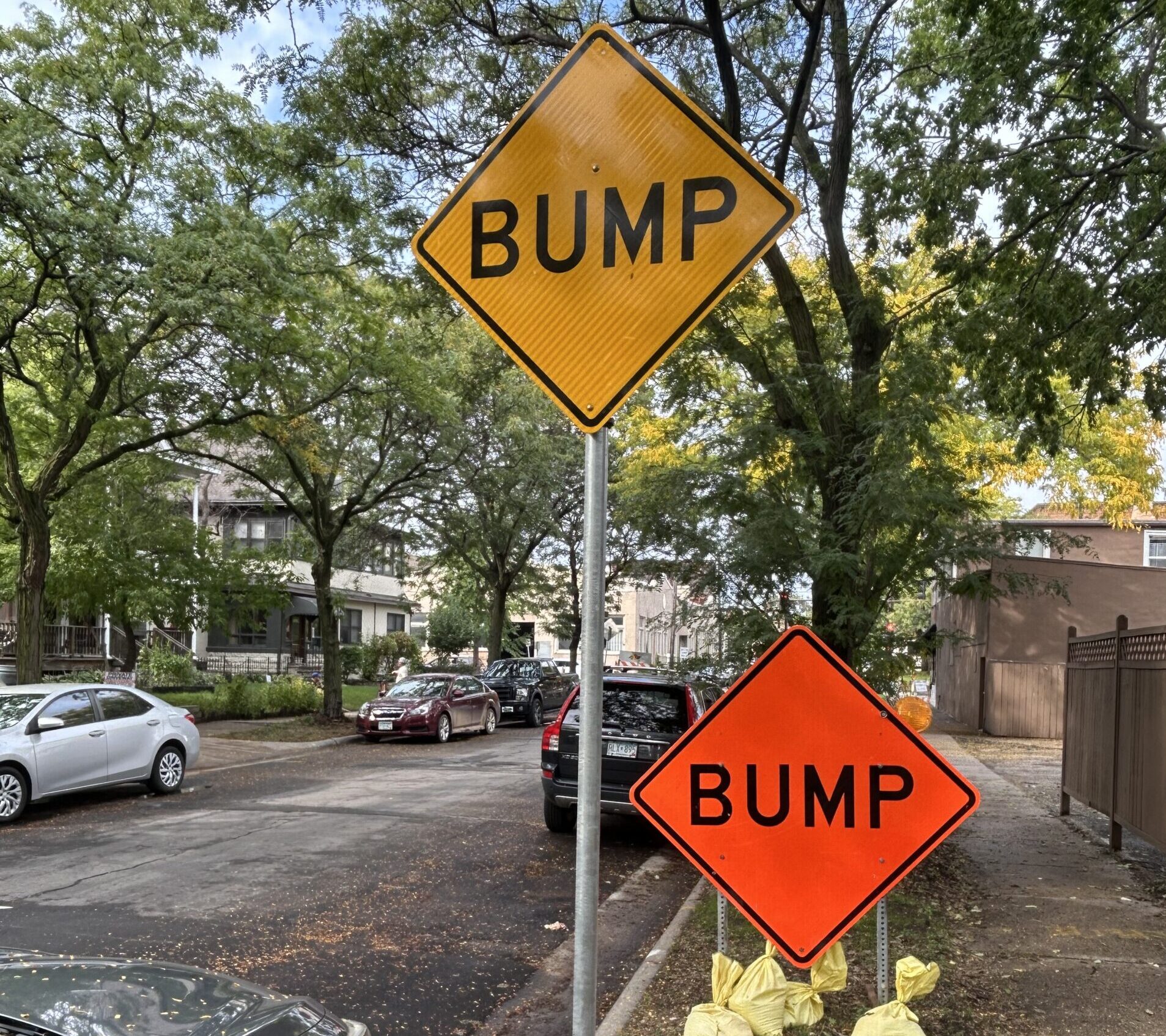

Bumps, humps, and circles now dot the Wedge neighborhood following a successful summer of traffic calming work by the City, although a considerable chunk of praise ought to also be lavished on the Wedgies who spammed the traffic calming request map with suggested improvements to our neighborhoods streets. Although planned work is not entirely complete (here’s looking at you ominous intersection chalk circles). Once the trucks, vests, and cones pack up and roll out for good the Wedge will be home to 18 new speed bumps and 4 traffic circles. For those of you who, like myself, enjoy sleeping with the window open, the motivation for such improvements was clear – the streets of our neighborhood facilitate dangerous driving. So, is that that? Should we expect these improvements to result in an appreciable difference when it comes to the ability of our streets to serve as inviting tarmac to would-be speeders?
In Minneapolis, 9% of the existing city street network accounts for 66% of fatal and serious injury crashes. These streets are termed High Injury Streets. The Wedge contains 8 High Injury Streets: Hennepin, Lyndale, Franklin, Lagoon, 24th, 26th, and 28th. None of which saw traffic calming improvements over the summer; although, to be fair, Hennepin Ave did recently benefit from much needed improvements following its 2025 redesign. Currently the Wedge is one of the most dangerous neighborhoods with regards to severe and fatal crashes per 1,000 residents (more than 3.34 – the highest category). Pedestrians and cyclists are disproportionately affected by serious crashes. Despite making up only 3% of trips, cyclists represent 10% of serious injuries and deaths (for pedestrians, the numbers are 17% and 30%). Do the math and you will see that our streets are built to protect auto drivers; who make 75% of trips but only represent 48% of serious injuries and deaths. Motorists are also causing the accidents; responsible for 62% of crashes. Some Census tracks in the Wedge see more than 40 pedestrian crashes per 1,000 residents – some of the highest outside of downtown. A majority, close to 80%, of crashes are a result of speeding.
However, non-inclusion of High Injury Streets in this summers traffic calming projects may have been in part due to a lack of requests from the community. Of the 39 requests submitted by neighbors for the Wedge, a majority of them are for north-south roads, with only one (for a traffic circle) being suggested for a High Injury Street. Although, there is a caveat, in that the map provided by the city only shows geographic, not substantive, information – meaning there is no way of knowing if the text associated with each request mentioned areas immediately around or down-road from where the pin was placed.
So, can our new road pimples still reduce dangerous driving by motorists? Theoretically, yes. Research by the National Highway and Traffic Safety Administration shows that speed bumps can reduce speeds by up to 10mph. This reduction will be especially welcomed by children – the choice prey of the ever-pervasive urban SUV – with speed bumps shown to decrease the odds of injury during a crash scenario involving children by roughly 2-fold. What is less certain is whether or not the added improvements will chip away at the Wedges ignoble title as one of the more dangerous neighborhoods when it comes to severe and fatal road accidents. While the improvements were much needed – there is still work to be done to create a neighborhood that is safe for all. A neighborhood where children can play in the streets, pedestrians can cross roads safely, and neighbors can sleep peacefully with their windows open.
Subscribe to E-news!
Get the latest events, news, and neighborhood updates!